
Bloons TD Battles
ninja kiwiStrategy
4.3105.84K Reviews
- Version
- 6.24
- Installs
- 10.00M
- Age Rating
- Everyone
Screenshots
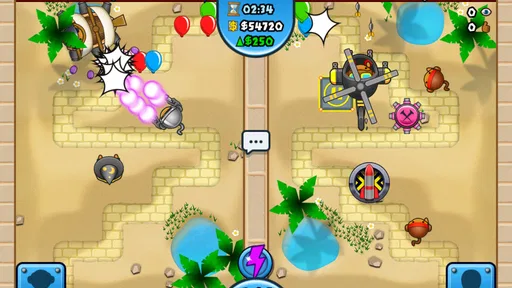
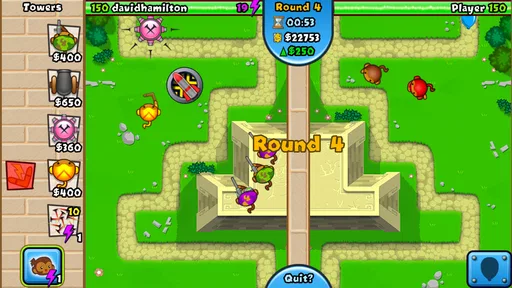
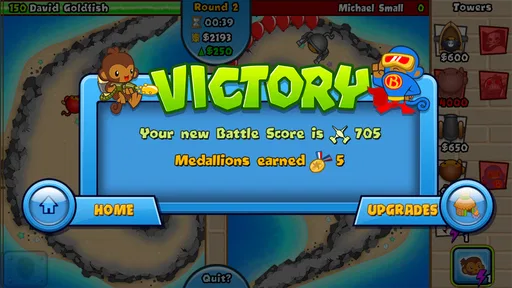
Our Review of Bloons TD Battles
 Analysis by Appyee
I went into Bloons TD Battles expecting a familiar tower-defense game with a competitive wrapper, but its real appeal became clear after several sessions: it turns the usual quiet planning of tower defense into a tense conversation between two players. Every round asks me to balance defense, income, timing, and pressure. I am not simply building a perfect setup against predictable waves; I am trying to read another person while keeping my own side from collapsing.
That makes this a particularly interesting strategy game for short sessions. It is free to play, rated Everyone, and comes from ninja kiwi, the developer behind the Bloons series. The game has been available since July 18, 2013, yet it still has a substantial audience, with over 10 million installs and an average rating of 4.3 from roughly 912 thousand ratings. Those numbers do not guarantee that every match will suit every player, but they do reflect how well the basic competitive idea has endured.
Why the first week feels so engaging
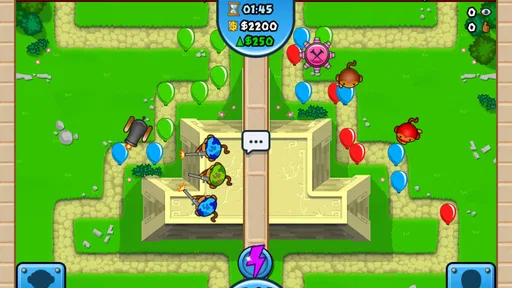
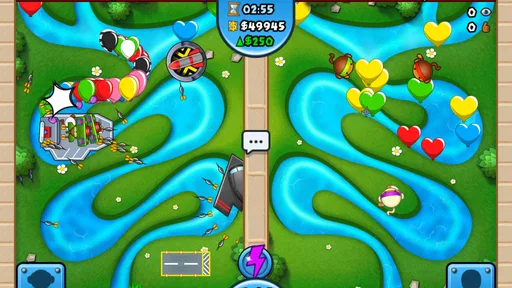
The opening sessions are easy to understand because the central conflict is immediately readable: monkeys defend against bloons while two players compete in real time. I can see the result of each decision quickly. A defensive purchase may stabilize my side, but it can also leave me without enough resources to create pressure. Saving for a stronger option may be worthwhile, yet one poorly judged round can make that plan impossible to recover.
That push and pull gives the game more personality than a standard tower-defense campaign. In a single-player alternative, I usually concentrate on solving the level in front of me. Here, I also think about what the opponent might be preparing. If the other side appears comfortable, I have to decide whether to improve my own defense or force them to respond. That decision is often more important than simply choosing the most powerful available upgrade.
The first week is especially good for discovering how much information can be gathered from small details. I watch the pace of the opponent’s development, notice when their defenses seem unusually thin, and pay attention to whether they are spending aggressively or building toward a later plan. Even without knowing every interaction immediately, I can learn to recognize when a player is taking a risk. The most useful early skill is not memorizing everything; it is learning when a safe-looking position is actually fragile.
Matches also have a satisfying rhythm. The early game gives me room to establish an economy and test the opponent’s reactions. The middle portion becomes more deliberate, since a few inefficient choices start to matter. Later rounds feel less forgiving, and the match can turn on timing rather than raw quantity. That progression makes a short play session feel complete, even when I lose, because I can usually identify the moment when my plan stopped working.
Learning without turning every match into homework
I appreciate that the game can be approached at several levels. A casual player can focus on placing towers sensibly and reacting to incoming pressure. A more committed player can study combinations, map space, upgrade timing, and the difference between a defense that survives now and one that remains useful later. The same match format supports both approaches, although the gap between them becomes noticeable once opponents know the game well.
My advice for a new player is to avoid changing the entire strategy after every defeat. Instead, I would review one question: did I lose because my defense was weak, because I spent too early, or because I failed to pressure the opponent? That simple habit makes improvement feel manageable. It also prevents the common mistake of copying a tactic without understanding why it works.
Another worthwhile habit is to treat the opening as an experiment rather than a race to use every resource. Spending everything immediately can create a strong visual defense while leaving no flexibility for the next problem. I found that keeping a small reserve often helped more than adding one extra tower too soon. The trade-off is uncomfortable, but it teaches the resource discipline that separates a stable plan from a desperate one.
What makes the competitive format different
Compared with ordinary tower-defense games, this one gives defensive decisions an emotional consequence. A mistake is not just a failed puzzle attempt; it may give the other player an opening. Conversely, a good response can make me feel that I have genuinely outthought someone rather than simply followed a known solution.
Compared with broader strategy games, the matches are more focused. I am not managing a large map, diplomacy, research tree, or several armies at once. That focus is a strength when I want a compact contest, but it also means the game can feel repetitive if I need constant novelty. The enjoyment depends on whether I like refining decisions inside a familiar framework.
The first-week appeal therefore comes from discovery and immediacy. I learn the basic flow, start recognizing patterns, and quickly understand why a small economic choice can affect the entire match. The danger is that early excitement can be mistaken for lasting depth. The more important question is whether the game continues to reward attention after the initial surprise fades.
What keeps it useful from month to month
For me, recurring value comes from the fact that another player changes the problem every time. Even when the available tools and general match structure remain familiar, the opponent’s priorities create variation. One person may play cautiously and force a long contest, while another may apply pressure early and make every purchase feel urgent. That human unpredictability is the main reason I can return after a break.
There is also a practical benefit for people who enjoy improving at a narrow skill. The game rewards timing, observation, and resource management more than passive waiting. I can set a small goal for a session, such as surviving the opening without overspending or identifying the opponent’s likely weakness before committing to an attack. Those goals make repeated play more purposeful than simply starting another match.
Still, the monthly value depends heavily on tolerance for repetition. This is not the ideal choice for someone who wants a constantly expanding adventure, a large narrative, or a relaxing tower-defense experience with no direct pressure. A campaign-focused game may be better if I want a sequence of handcrafted challenges. A slower strategy title may suit me more if I prefer planning without a live opponent interrupting the plan.
The free entry point makes experimentation easy, but the presence of in-app purchases means I would approach spending carefully. Items range from $0.99 to $99.99 each, so the game should be judged first on whether the basic loop is enjoyable without treating purchases as part of the routine. I would not spend simply because a losing streak made me impatient. Competitive games are much easier to enjoy when purchases are kept separate from the emotional urge to recover a bad session.
That is also why I recommend deciding on a personal spending boundary before playing regularly. The game can become a harmless daily habit when I treat it as a quick strategy contest, but frustration can make any competitive free game feel like it is asking for another investment. Keeping that distinction clear protects the part that is genuinely fun: making better decisions.
A realistic everyday use case
Imagine having a short break between errands or during a commute, with enough time for one focused activity but not enough attention for a long campaign. This is where the game fits naturally. I can enter a match, spend several minutes reading the situation, and finish with a clear result. It does not require me to remember a complicated story or rebuild a large world after being away for a week.
That convenience has a downside. Because matches are competitive and real time, I should not start one when I know I will need to leave suddenly. An interrupted match is unfair to the opponent and unsatisfying for me. The game works best when I can give the session uninterrupted attention, even if the overall play period is short.
For a regular routine, I would use it in small blocks rather than playing until every loss feels personal. Two or three matches can provide useful practice; continuing through frustration often produces worse decisions and teaches the wrong lessons. The game is good at creating a “one more match” feeling, so setting a stopping point is part of using it well.
How the game stays fresh, and where it does not
The freshness comes from matchup uncertainty and the need to adapt. I may begin with a familiar plan, but the opponent can expose its weakness. That encourages me to build a flexible understanding instead of relying on one script. I also enjoy the way a match can change direction: a player who looks ahead may suddenly become vulnerable after one inefficient choice, while a player under pressure can recover with a well-timed adjustment.
However, this same structure can make the game feel less fresh over time. The emotional shape of a match remains recognizable: establish, pressure, respond, stabilize, and survive the late contest. If I do not enjoy practicing the same kind of decision-making repeatedly, the novelty will disappear quickly. The game does not need a huge amount of content to work, but it does require me to value mastery.
Another source of variation is the opponent’s skill level, yet that can be a mixed blessing. A close match is exciting because every choice matters. A mismatch is less satisfying, whether I am overwhelmed before I understand what happened or winning against someone who cannot challenge my plan. The competitive format is at its best when both players are close enough in ability to punish mistakes without making the result feel predetermined.
The maintenance burden behind a lasting habit
One reason I can keep returning is that the game does not demand a large personal commitment outside the matches. I do not need to maintain a long checklist just to remain oriented. The important maintenance is mental: remembering what went wrong, noticing patterns, and resisting the temptation to play mechanically.
That makes the game relatively approachable after a break. I can return without needing to reconstruct a complicated story or recall dozens of disconnected objectives. At the same time, a returning player may feel rusty because timing and matchup knowledge are practical skills. The solution is not to chase difficult opponents immediately. I would use the first few sessions to regain decision speed and observe more than I attack.
The current version is 6.24, and the game supports devices running Android 5.0 or later. For someone choosing whether to install it, that makes compatibility worth checking before committing to a regular routine. On a supported device, the more important question is whether the screen, controls, and connection feel reliable enough for real-time play. A strategy decision is only satisfying when I can make it promptly and understand its result.
Maintenance also includes managing attention. The game is colorful and approachable, but the competitive layer asks for concentration. I would not describe every session as relaxing. Even a short match can leave me mentally busy because I am tracking income, defense, pressure, and the opponent’s behavior at once. That is a benefit when I want active engagement, but a drawback when I am looking for something calming after a tiring day.
Small practices that improve long-term enjoyment
I found three practices particularly helpful. First, I focus on one adjustment after each match instead of trying to rebuild my entire approach. This creates gradual improvement and keeps losses from becoming vague frustration. Second, I avoid spending resources just to make the board look safer; I ask whether the purchase solves the next likely threat. Third, I vary my opening decisions occasionally, not because every experiment is optimal, but because it reveals which parts of my usual plan are genuinely necessary.
A fourth practice is to separate scouting from panic. When the opponent changes direction, my first reaction may be to answer immediately. Sometimes that is correct, but sometimes the threat is designed to make me waste resources. Taking a moment to distinguish a real weakness from a distraction is one of the most transferable strategic lessons in the game.
I also recommend treating the final portion of a match as a test of preparation rather than a separate phase. If my defense only works while everything goes according to plan, it was never truly stable. Saving enough flexibility for an unexpected turn is less flashy than making an aggressive purchase, but it makes the overall experience more consistent.
Where fatigue begins to show
The biggest source of fatigue is repetition combined with emotional pressure. Losing because I misunderstood a strategy can be useful. Losing several times in a row to situations that feel similar can make the game seem narrower than it is. The competitive format magnifies this effect because every match asks me to care about the outcome.
There is also a learning curve that can feel uneven. Basic play is accessible, but stronger opponents may punish details that are invisible to a beginner. Without patience, I may conclude that the game is random or unfair when the real issue is that I have not yet learned how to read the situation. That does not remove the frustration; it simply explains why the game is more demanding than its cheerful presentation suggests.
Another limitation is that the game is not a substitute for a deep single-player tower-defense campaign. If I want to pause freely, test a build without an opponent, or solve a carefully designed level at my own pace, a traditional campaign will probably serve me better. This title’s identity depends on confrontation, so removing that pressure would also remove much of its purpose.
The in-app purchase range can add another layer of concern for some players. Free access is convenient, but I would be cautious about allowing competitive frustration to influence spending. Parents should also remember that an Everyone rating describes the content suitability, not whether the competitive loop will be a good fit for every child’s patience or spending habits. The game is approachable, but its pressure and purchase options still deserve ordinary household boundaries.
Fatigue can also come from playing too long in one sitting. Early matches may feel varied because I am learning. Later, I may notice that my attention is narrowing and that I am repeating the same response without evaluating it. At that point, stopping is more useful than forcing another match. A short break can preserve the game’s strategic character instead of turning it into background tapping.
Who should make room for it, and who should skip it
I would recommend it to someone who enjoys tower defense but wants direct competition, quick decisions, and a reason to study opponents. It is especially suitable for players who like improving through repeated matches and do not need a large story to justify returning. The free price also makes it easy to try before deciding whether the long-term loop has enough depth for personal taste.
I would be more cautious recommending it to someone seeking a peaceful mobile game, a rich campaign, or a strategy experience that can be paused whenever life interrupts. Players who dislike real-time pressure may find the opponent’s presence more stressful than exciting. Likewise, anyone who tends to chase losses through repeated matches or impulsive purchases should approach the competitive loop with a clear stopping rule.
Compared with a standard tower-defense alternative, this game offers more replay value through human unpredictability but less control over the pace. Compared with a larger competitive strategy game, it is easier to understand and quicker to enter, but it does not provide the same broad range of systems to manage. Its best audience sits between those two groups: people who want focused strategy, not a full-scale management simulation.
My long-term verdict
After the novelty fades, Bloons TD Battles earns lasting space only if I enjoy the process of refinement. Its strongest feature is not the first colorful match; it is the way a familiar defense can become a different problem when another player makes an unexpected choice. That gives the game a durable core, provided I am willing to learn from losses and accept that improvement may be gradual.
I like that it can fit into a regular routine without demanding a large campaign commitment. A few focused matches can provide a clear mental challenge, and the simple premise hides more decision-making than it initially suggests. The game’s age has not made the central contest irrelevant. Instead, its continued appeal comes from a format that is easy to start but difficult to master casually.
My reservations are equally clear. Repetition can become tiring, real-time matches are not ideal for unreliable schedules, and the competitive environment may expose a wide skill gap. The in-app purchase range also means I would keep spending firmly under control. None of these issues ruins the experience, but they determine whether it becomes a healthy habit or an irritating cycle.
For me, the best way to use it is as a deliberate short-session strategy game: start when I have enough uninterrupted time, set a modest learning goal, and stop before frustration takes over. If that sounds appealing, the free download is worth trying. If I want a relaxed campaign or a constantly changing adventure, I would choose a different tower-defense game instead.
Overall, ninja kiwi has built a competitive strategy game with genuine staying power, but its long-term value is personal rather than automatic. The game rewards curiosity, restraint, and close attention to timing. It does not need to become a daily obligation to be worthwhile. In my experience, it earns a place on a phone when I treat it as a focused contest to improve at—not as an endless demand for another match.
Verdict
Strengths of Bloons TD Battles
- Fast matches make it easy to play during short breaks.
- Large tower variety supports many different attack strategies.
- Replay system helps you study mistakes and improve your tactics.
- Cartoon visuals are colorful, clear, and easy to understand.
- Frequent events and challenges add extra goals beyond standard matches.
Limitations of Bloons TD Battles
- Some advanced towers and upgrades require significant grinding to unlock.
- Matchmaking can feel uneven when facing highly experienced players.
- Online play depends on a stable connection for smooth battles.
- The small battlefield can make late-game action feel visually crowded.
- Random map and tower choices may limit strategic freedom in some matches.
Other Releases by ninja kiwi
View All
SAS: Zombie Assault 4
Action4.4

Bloons Adventure Time TD
Strategy4.5

Bloons TD 6
Strategy4.8

Bloons TD 5
Strategy4.6
Similar Picks in This Category
View All
Clash of Clans
Supercell4.5

Plants vs. Zombies™
ELECTRONIC ARTS3.7

Lords Mobile: Kingdom Wars
IGG.COM4.5

Clash Royale
Supercell4.4

State.io — Conquer the World
CASUAL AZUR GAMES4.1

Car Driving School : Car Games
Spark Game Studios3.9
Frequently Asked Questions
What is Bloons TD Battles?
Bloons TD Battles is a competitive tower defense game based on the Bloons series. Instead of defending against computer-controlled waves alone, you send bloons toward an opponent while building monkey towers to stop their attack. Matches require quick decisions, careful economy management, and an understanding of each tower’s strengths. It is easy to start, but winning consistently takes practice and strategic planning.
Is Bloons TD Battles free to download and play?
Yes, Bloons TD Battles can generally be downloaded and played for free on supported Android and iOS devices. The game may include optional in-app purchases, such as premium currency, cosmetic items, or other conveniences depending on the version and platform. You can enjoy the main competitive experience without paying, although progression and certain unlocks may require time or optional purchases.
Can I play Bloons TD Battles offline?
Bloons TD Battles is primarily designed as an online multiplayer game, so an internet connection is normally required for competitive matches, account features, leaderboards, and other online content. Some menus or limited practice features may work without a connection, but the complete experience depends on online services. A stable connection is recommended to avoid disconnections or matchmaking problems.
Does Bloons TD Battles support multiplayer and cross-platform play?
Multiplayer is the central feature of Bloons TD Battles, allowing you to compete against other players in real-time matches. Depending on the specific edition, server setup, and current platform support, cross-platform play may be available between compatible devices, but it should not be assumed for every version. Check the store listing and in-game information before downloading if playing with friends is important.
Is Bloons TD Battles suitable for beginners?
Bloons TD Battles is suitable for beginners, especially because its basic objective is straightforward: defend against incoming bloons while pressuring your opponent. However, the competitive format can feel demanding at first. New players need to learn tower upgrades, bloon types, map layouts, income management, and effective timing. Starting with tutorials or practice matches is a good way to understand the mechanics before entering serious competition.
Play our best games!


